Stop judging an event by how busy the aisle looked
A busy stand feels great on the day. Your pipeline three months later tells you whether it was worth it.
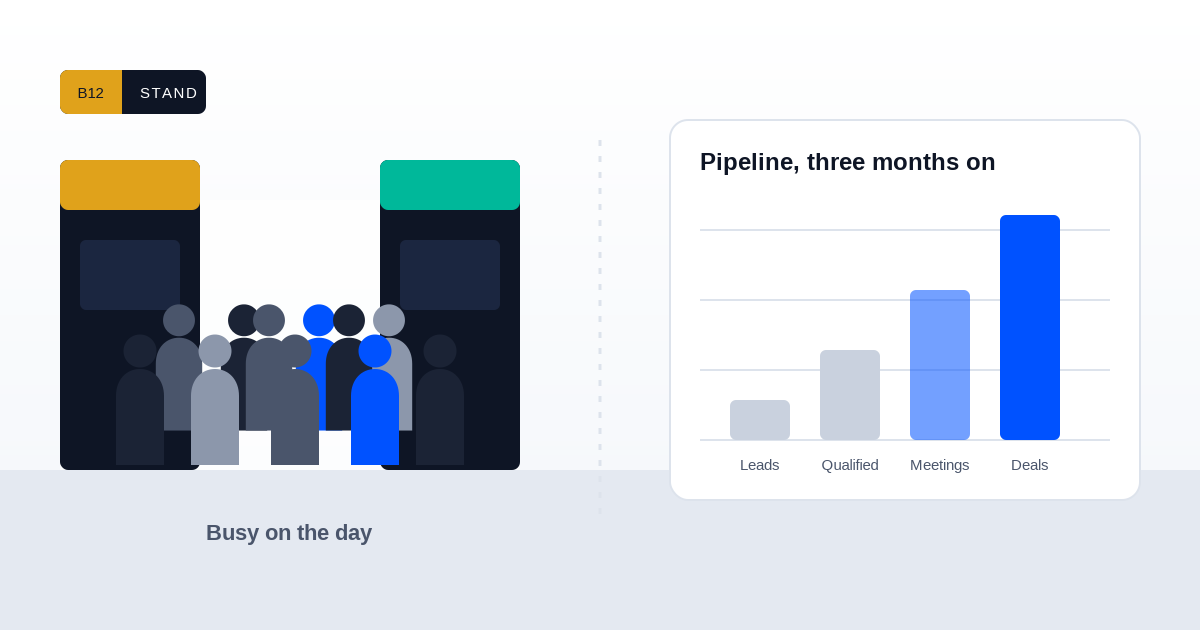
For many exhibitors and sponsors, the verdict on an event is reached on the train home. Was it busy? Did we get lots of scans? Did the stand look good? Those things matter, but they're a poor test of whether an event earned its place in next year's budget.
The statistic we nearly used, and why we didn't
You've probably heard that “80% of trade show leads are never followed up”. It's usually credited to the Center for Exhibition Industry Research (CEIR). But CEIR says it never produced the figure, and versions of 80%, 85% and 87% circulate with no traceable source. If you're going to tell exhibitors they're wasting their leads, you need better evidence than that.
What the evidence does say
CEIR's own study of nearly 200 exhibitors paints a more useful picture. Most exhibitors do follow up: tailored emails (64%) and tailored phone calls (59%) are the most common methods, and over 70% of those using them follow up within two weeks. The weak point is earlier. Only 30% capture qualifying questions beyond contact details and product interest. A 2010 survey sponsored by Lynch Exhibits and In4med found fewer than 70% of exhibitors had a formal follow-up plan. So the problem usually isn't laziness. It's that exhibitors collect plenty of names and too little about whether they're buyers.
Footfall isn't the same as value
A crowded stand can be full of students, other suppliers and people after the coffee. A quieter one might have had three conversations with buyers who are actively in the market. What buyers say they value backs this up: Freeman found 57% of attendees rate hands-on demonstrations as the most useful way to evaluate products, and 84% say access to subject-matter experts is extremely or very important. Those are quality conversations, not traffic.
What smart sponsors already measure
The marketers who sponsor events have moved on from scan counts. In IDC’s 2026 sponsor survey of 150 senior B2B tech marketers, the top success measures were cost per opportunity, lead quality and conversion, and deal influence in key accounts. More than 90% said events deliver most value in the middle and later stages of the buying journey. That's pipeline language, not footfall language.
Source: IDC 2026 Sponsor Survey (US, UK, Germany, Singapore), October 2025
Decide what success looks like before you go
The biggest change most exhibitors can make is to set their goals before the event, not afterwards. How many meetings, with which kinds of company? Which clients do you want to see? Which prospects do you want to move forward? With that in place, it's easier to judge the event honestly and to brief the team on how to spend their time.
Buy the package that fits the goal
If the goal is meetings with buyers, a big stand might not be the best use of the budget. If it's visibility with a new audience, a speaking slot or content partnership might do more. The right package depends on the goal, not on what the brochure puts at the top.
Sources
- American Image: the 80% follow-up statistic
- Exhibit City News: CEIR lead capture and follow-up study (2012)
- Trade Show Executive: Freeman 2025 research highlights
- IDC, 2026 Sponsor Survey (Oct 2025)
Every figure in this post was checked against the source linked above. Where trusted data doesn't exist, we say so.